
An integral component of any form of design is legibility. Legibility, simply put, can be understood as the organisation of matter coherently. By accessing a legible space, one must be able to analyse their environment and construct a clear mental image. This legibility can be of varying degree and although it is impossible to quantify it, there are several tools architects and designers use to organise information in a way that it is legible to readers. One such tool is the axis.

The axis is a design principle where all elements are organised in a line, imaginary or otherwise. It is used to align elements, reinforce the division of space, create continuity, structure symmetry and maintain a certain order. It has qualities of length and direction and induces movement along with it. An example of this would be the album list on iTunes or Spotify where songs are arranged one below the other, album covers on the left and the name of the song and artist to the right with a vertical axis separating them.
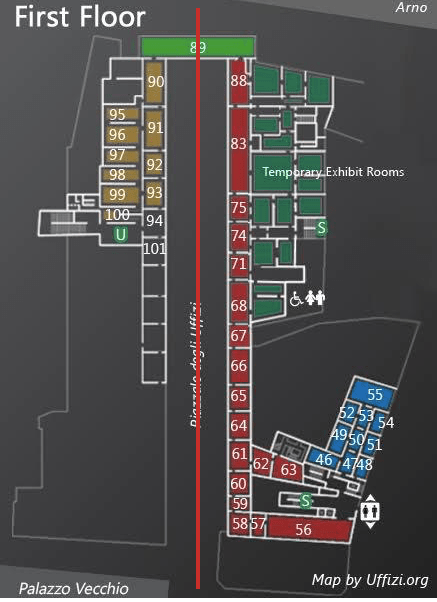
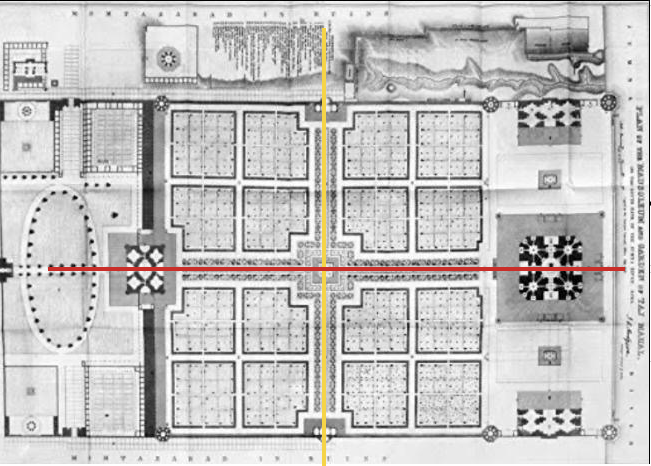
Axes have been used widely in architecture, some examples being Uffizi gallery in Florence, Italy and Taj Mahal in Agra, India. Axes usually have an anchor point and in most cases, there exists minor axes or cross axes that run perpendicular to the major axis. These cross axes create more choices and opportunities for the person to choose from.
Shown below, are the architectural plans of the Uffizi Gallery in Florence, Italy and The Taj Mahal in Agra, India. The Red line represents the major axis and the yellow represents the minor axis. The presence of the minor axis allows people to choose which path they want to follow.
It is important to note, however, that the architect or designer doesn’t use axes arbitrarily in design. It can hold several meanings when used in different ways. Architecture has always been an effective way to exhibit power or authority and axiality is one of the simplest forms of exercising this power. In many cases, it is used to create a sense of spatial hierarchy. This is commonly used in religious architecture, where the axis is used in a way that there is a progression from the least to most sacred space within a place of worship.
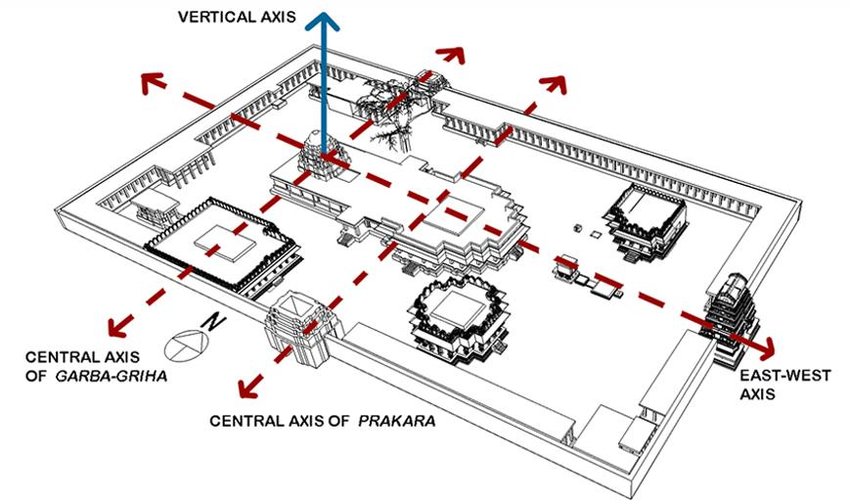
image source : research gate
To the right, is an axonometric of the Vithilla Temple in Hampi, India. Apart from the horizontal axis, there is also a vertical axis which moves upward from the shikhara. The point of intersection is where most of the religious practices are held and the idol is placed, as it is considered most sacred.

image source: trover.com
While defining axes, it is important to discuss another movement system, the path. While the axis allows the mind to connect two points in a line, the path allows the mind to wander. A Path allows for more choice. This, however, doesn’t mean that it is always different from an axis. In some cases, two places are connected in a single line without any breaking of alignment or minor axis, in which cases the path taken is the same as the axis. In a situation where there are choices, the path is created by the person moving through it and it allows them to wander. In the case of Stourhead in England, there is no axis present and the person is forced to take the path created by the architect. Here, the person is meant to wander and make choices along the way.
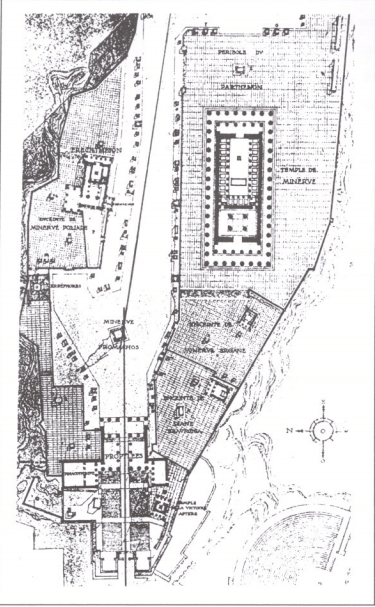
Another commonly used device in architecture is the deliberate breaking of the alignment of the axis. This is done to create multiplicities and allow more choice. Breaking of the axis creates a sense of spatial diversity and emphasises the importance of endpoints. By delaying the perception of the endpoint, monumentality and divinity of the endpoint increases. This is seen in the axis of Metropolis in Athens.
information and image source https://core.ac.uk/download/pdf/47252162.pdf.
The picture to the extreme left below is an example of an axis made with five everyday objects. The image to its right shows a progressional axis in order of magnitude, i.e smallest to largest object or vice versa. This kind of axis is more deliberate than the first one. The third picture to the extreme right is an axis created to evoke an emotion of claustrophobia. Here, there is a narrow tunnel-like object that opens into a flap-like object which appears to be closing in.
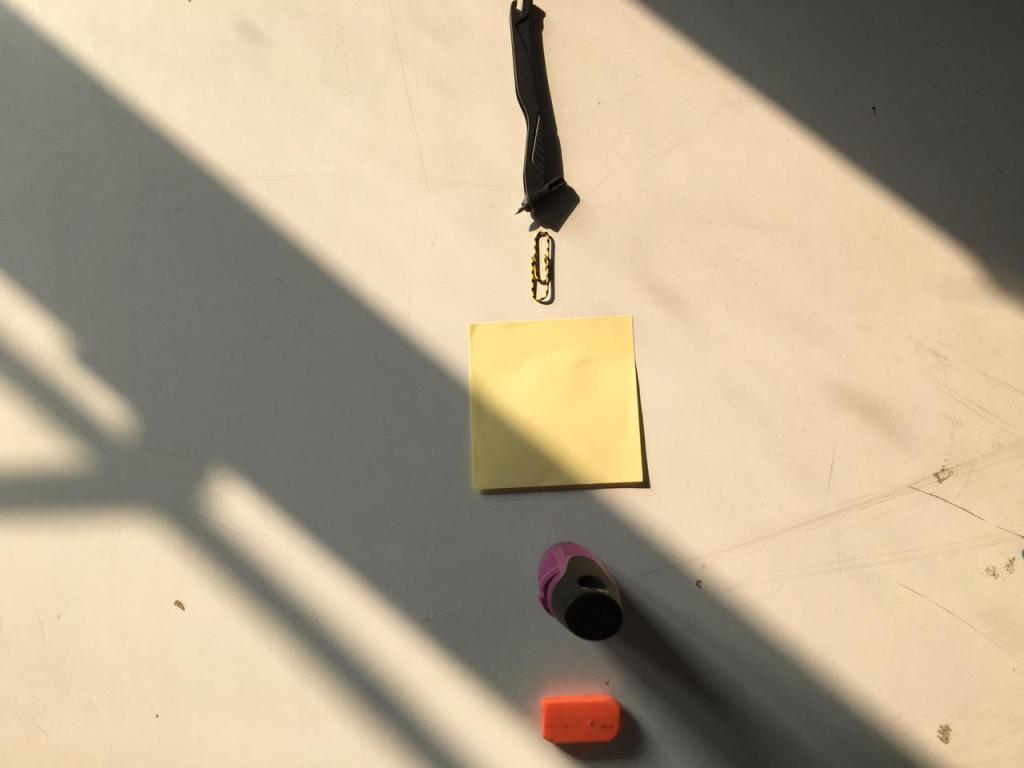
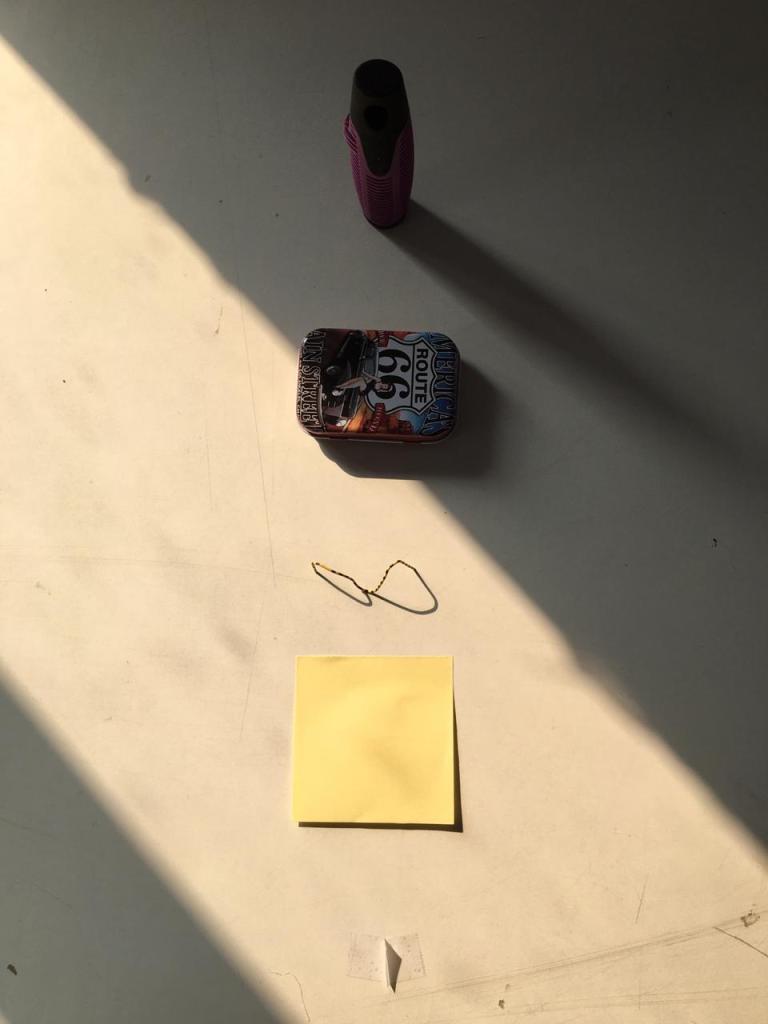
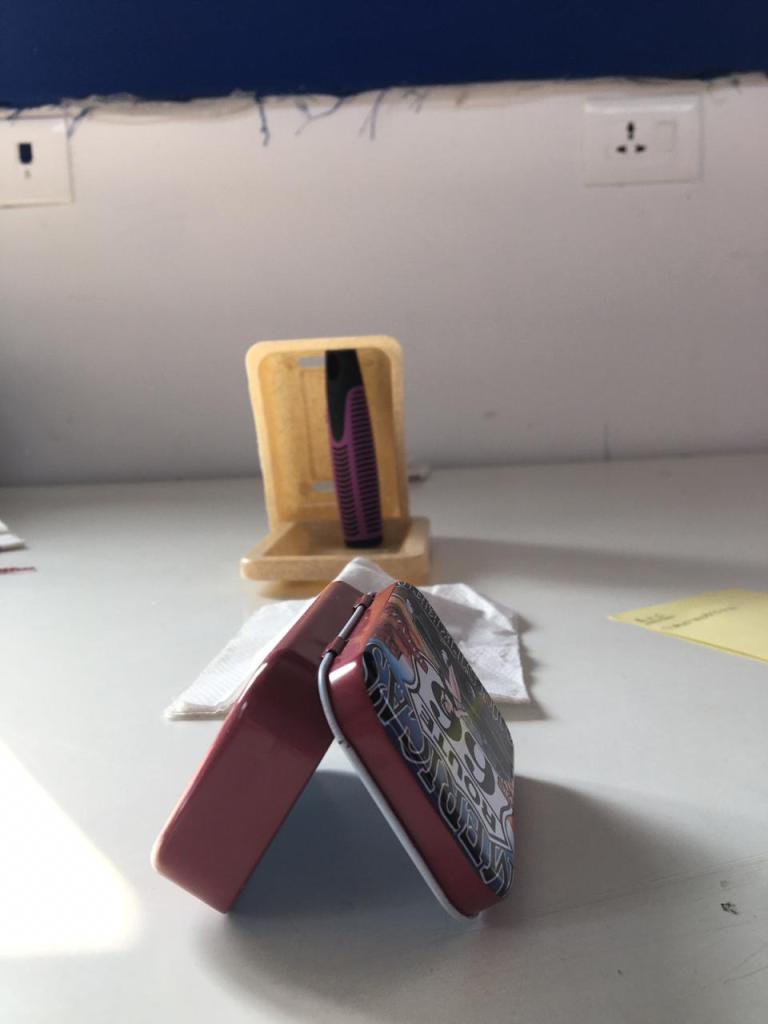
From this simple exercise, it is evident how the arrangement of objects in a particular way can evoke a certain emotion or create a sense of importance within itself. If we translate this to a larger scale, we can start to understand why this tool of axiality is so powerful and why designers and architects use it widely in all fields of design today.
 the girl in the beanie
This is lengthy but informative – please note an axis in urban space is not equivalent to the guideline in a screen composition – axes mark and predetermine idealised movement and progression. The models are easy to see, but still a little hard to understand in terms of the erudite description of axes… can we learn more PRECISELY about the insights and decisions you are personally making, and get to brevity by reducing the number of words in general descriptions?
LikeLike
Thank you so much for the feedback. I apologise for the association of the axis with screen composition, I’ll read more about it. I will also make sure that the following blog entries are reflective and to the point.
LikeLike